
REAL AND IMAGINED OBSTACLES KEEPING YOU FROM JUMPING IN
*This page contains affiliate links
I’m going to assume you want to write a graphic novel, but aren’t quite sure where to begin. If you’re still on the fence because you are a writer and not an artist, I recommend you read this post first.
When I first decided I wanted to write a graphic novel, I quickly felt overwhelmed with all the questions and the complicated way everything was connected. Here are some of the obstacles I faced:
- What if I can’t draw worth beans?
- What does a graphic novel script even look like?
- How will the illustrator even know what I want it to look like or who says what and when?
- How many pages should the script be?
- What program do I use to write the script?
- What kind of genres work well?
- How marketable are the different genres?
- How do I decide if my story should even be a graphic novel?
- How do I find a collaborator?
- Where do I start?
If this is you, take a breath. I’m going to break it down for you so you can feel just confident enough to take the next step. Then, if you follow along in this series of posts, you will have the tools you need to complete all the necessary steps and write your first graphic novel.
Graphic novel or prose?
Like with all stories, you begin with an idea. It’s a pretty good idea and you love it enough to pursue it. Now you wonder if it’ll be best as a graphic novel.
Sometimes, that’s fairly easy to assess. For example, you have a main character who can’t talk or is deaf. Visual storytelling could be a very good way to tell their story. But most times, it’s about the story’s focus.
Do you want a lot of self-reflection, detailed information, or flowery language? Prose will probably suit you best.
But if want to focus on setting, plot, or character interaction, a graphic novel could be perfect. Any genre can work well as a graphic novel. In middle grade, my favorite genre is memoir or contemporary. But I have enjoyed fantasy, mystery, and historical, as well.
“Any genre can work well as a graphic novel.“
Graphic novels are very focused, the same way short stories are focused. I know. I know. I used that word already. What I mean is that there’s no room for meandering or extraneous explanations about the language of an obscure species. Graphic novels have one main plot with maybe one subplot. Think one episode of your favorite tv show. So, if your idea is complicated, consider writing it as a prose novel instead.
This brings us to the next question:
How many pages?
Prose novels are usually measured in word length, but that doesn’t really work with graphic novels because the majority of the words in the script will not end up in the book as words. So, we have to measure in pages.
- Young adult graphic novels are usually between 200-400 pages long. (Ink Girls is 288 pages)
- Middle grade graphic novels average 200 pages. (Real Friends is 226 pages)
- Books for younger readers might be 100-150 pages. (Mr. Wolf’s Class is 166 pages)
- Books for emerging readers are often around 32-62 pages, certainly under 100. (Birtle and the Purple Turtles is 80 pages.)
Knowing these stats helps, but you may still feel blind writing you story. I remember winging it and hoping I was keeping my story short enough to fit the page expectations.
When writing your script, it’s helpful to outline the story beats first. Those beats are each a scene and not a lot will happen between the beats. A graphic novel chapter might only contain one scene. This will keep the story tight and the scope of the project manageable.
What about the script?
First, to the frustration of all graphic novelists, there is no industry standard yet. When I started, there were many resources and I just used the script template in Scrivener. I got used to the short cuts and was able to write fairly quickly.
That script resembles a play script with the dialog center aligned. It doesn’t work very well for sound effects or a couple other graphic novel-specific needs.
Graphic novelist, Brigitta Blair, created a new template we can use in Scrivener, and Steenz put together a standard base for collaborative teams, complete with instructions on how to use Brigitta’s scrivener template to write a script.
This is a game-changer. You should definitely download it (it’s free) and read through the instructions.
Here’s the example from their page:
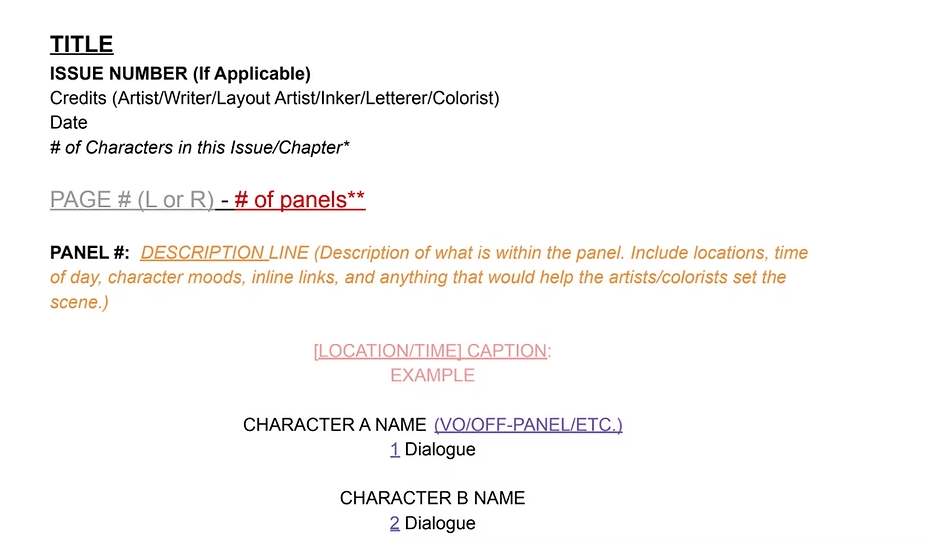
I will show real-world examples in other posts. But here you can see what kind of things you need to write into the script so your collaborators can clearly see what you envision.
If you don’t know all the jargon in the example above, don’t worry. I’ll cover that in another post. Your illustrator will know what all of this means, so they’ll know the mood, whether a character is speaking on screen or from off panel. They’ll know where you intend to have a page turn, etc.
And that’s the basics really. You’ve got the tools, next we will talk about storytelling in graphic novels. This is where your skills as a writer will excel. Be sure to subscribe to get notified when that lands next week.
Still have questions I didn’t cover here? Drop them in the comments or in my Substack community.
Not sure whether you want to try your hand at graphic novels? Read this post.
Want to read more original work? Check out my Medium account for flash fiction, personal essays, and articles.
Be sure to subscribe to my newsletter: WITH LOVE, FROM THE FUTURE for more personal letters and updates.
You can find my book recommendations in my Bookshop, Amerixicana Books.
And if you are looking for classic literature for class, or for your home collection, check out my publishing imprint, Simply Classic Books.
 D. Higbee
Leave a comment